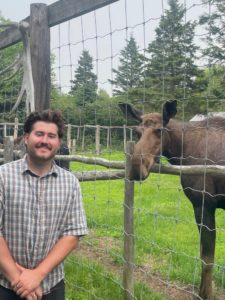
Leonardo Tellez
MSc Student
Contact Information
Department of Biology
Concordia University (Loyola Campus)
7141 Sherbrooke St. W. H4B 1R6
Montreal, QC, Canada
Office: SP 434
Lab: SP434
(514) 848-2424 (ext. 4021)
Education
2026 – Present: MSc student in Biology at Concordia University, Montreal, Canada
2023-2026: BSc in Biology (Specialization in Ecology), Université du Québec à Montréal (UQAM), Quebec, Canada
My Project
Effect of recreational activities such as hiking on the behaviour of moose (Alces alces) in Quebec
Background
The practice of nature-based activities has strongly increased since the mid-twentieth century. Besides the economic value and the beneficial effects on health, nature-based activities have been shown to play an important role in the protection of nature, by bringing people closer to nature. If, on the one hand, recreational activities may boost conservation efforts, on the other hand, they embody potential threats to wildlife. For moose, humans are generally perceived negatively, often triggering spatial and/or temporal avoidance. Paradoxically, many environments frequented and exploited by humans offer nutrition sources of great interest for moose. Moreover, in certain conditions, human disturbance can reduce predator presence. These two phenomena can promote a cohabitation between the cervid and humans. Moose are a common animal in North American parks and can be a threat when in close encounter with humans and vehicles. Understanding the mechanisms and factors promoting proximity between this large mammal and humans can allow park managers to put in place measures to prevent future human-wildlife impacts (conflicts).
Field Work
The study will take place during the summer of 2027 in the national park of Gaspésie. The recording of data will be done in partnership with the Société des établissements de plein air du Québec (Sépaq).
Objectives
The main goals of this project are to:
- Investigate which environmental factors promote a tolerance or an avoidance to humans;
- Measure to what extents the different responses of moose are explained by food quality, hiker traffic, temperature and predation risk.
Publications
xxx
xxx